
- Core Projects
ATLANTIDA II (NORTE2030-FEDER-01799200)
The North Atlantic coastal observatory in Portugal will intervene at the level of physical, chemical, biological and microbiological components, carrying out a detailed mapping of the northern coastal strip, thus becoming a fundamental instrument to support political, scientific and economic decision-making (from fishing to offshore energy production, including the emerging blue and environmental bio-economy).
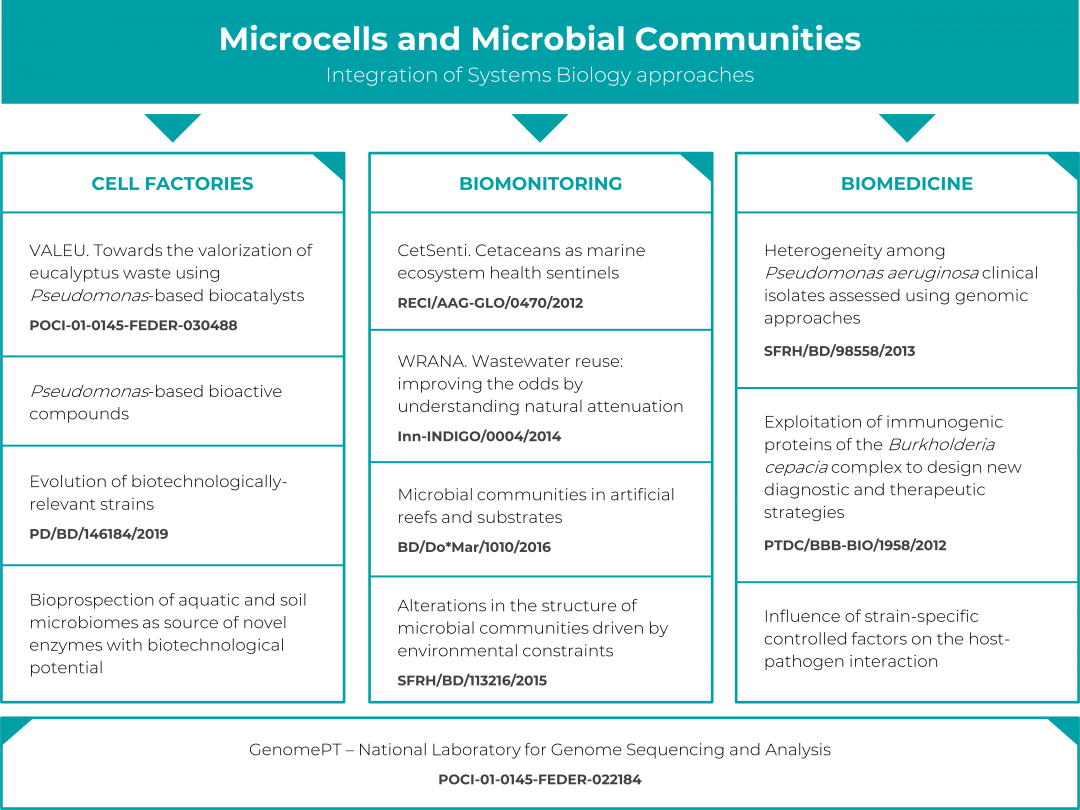
Evolution of biotechnologically-relevant genomic islands
Funding Program: FCT PhD Programmes
Reference: PD/BD/146184/2019
Monoterpenes are widely used in industrial processes as precursors of value-added compounds, however these compounds are usually hydrophobic and toxic for most microorganisms. Pseudomonas sp. M1 is able to mineralize β-myrcene, and other monoterpenes, due to the expression of a specialized set of genes present in a novel 28-kb genomic island.
When M1 cells are challenged with β-myrcene, the expression of 8 transcriptional units within the genomic island, involved in the substrate sensing, gene expression regulation, and β-myrcene oxidation and bioconversion into the central metabolism, is triggered. During this process, Pseudomonas sp. M1 produces a number of industrially relevant intermediates (e.g. the myrcen-8-ol used in scent formulations and the pheromone-like 4-methylhexanoic).
The main goal of this research line is to improve the biotransformation performance of Pseudomonas sp. M1, resorting to laboratory evolution. From an industrial perspective, the efficient utilization of the nutrient source is imperative, giving relevance to these experiments. Furthermore, the adaptation of the microorganisms to specific environments (e.g., presence of solvents and other highly hydrophobic compounds) is also desirable, allowing them to better cope with challenging setups. In such experiments, microorganisms are grown in selective conditions imposed by the operator, resulting in controlled stress to the population, during several generations. Mutations occur randomly in the genome, some conferring growth advantages in the imposed environment. Thus, overtime, lineages with such mutations fixate its genome in the population, co-existing or even replacing the original population.
In our research group, Pseudomonas sp. M1 was submitted to long-term evolution during 600 generations, using β-myrcene or lactate as sole carbon and energy sources. The study of the evolved communities and isolated colonies in different time-points, using genomics and metabolomics approaches, will identify mutants with improved biotransformation performance as well as tackle the mechanisms behind the evolution of Pseudomonas species, namely regarding hydrophobic compounds.
Moreover, envisaging the valorization of eucalyptus waste produced for instance in the paper industry, the biotransformation performance of the evolved isolates retrieved from this research line will be tested for eucalyptus waste, contributing to the output of the project VALEU.
Heterogeneity among Pseudomonas aeruginosa clinical isolates assessed using genomic approaches
Funding Program: FCT PhD Studentships
Reference: SFRH/BD/98558/2013
Pseudomonas aeruginosa, a ubiquitous pathogen, is a leading cause of opportunistic infections, as a result of its multifactorial pathogenicity, multidrug-resistance and genomic plasticity characteristics. These features allow a strain-specific versatile adaptability to different loci and stressors, being the ability of P. aeruginosa to alter its lifestyle in response to changes in environmental conditions, widely described.
From a collaboration with Hospital de Braga, we raised a collection of over 700 P. aeruginosa clinical isolates from different sources (lung, urinary tract and wound infections, cancer, sepsis, cystic fibrosis, among others), unlike other collections reported in the literature mostly associated with a particular source or phenotype. Under the scope of “The 1000 Pseudomonas aeruginosa Genomes Project”, supported by an international consortium, this collection was explored to correlate phenotypic variability, as antibiotic resistance and pathogenicity, with genomic plasticity, thus generating information and tools to more efficiently circumvent P. aeruginosa infections.
Specifically under this project, our team aimed to:
- Provide a systematic characterization of P. aeruginosa isolates occurring in that Hospital by clustering according to their genotype;
- Determine and compare the genome sequence of representatives isolates (identification of variations in genomic content, SNVs and indels);
- Evaluate the molecular mechanisms underlying phenotypic heterogeneity among selected isolates from similar clinical backgrounds.
- Assay the influence of specific factors on the bacterial pathogenic potential against a human pulmonary epithelial cell line model.
Expanding the strategies followed in this project to other P. aeruginosa clinical isolates and integrating data from genomics, proteomics and transcriptomics with the clinical outcome will improve the ability to understand host-pathogen interactions and the molecular basis of bacterial infections. Ultimately, an improved understanding of the adaptive response in distinct infection stages may aid in finding new biomarkers and developing new therapeutic strategies to overcome Pseudomonas aeruginosa infections.
- Collaborative Projects
GenomePT – National Laboratory for Genome Sequencing and Analysis
Funding Program: FCT & FEDER trough COMPETE 2020 (POCI)
Reference: POCI-01-0145-FEDER-022184
Genome sequencing and analysis is fueling a major revolution in biological, biomedical, environmental, agricultural and marine sciences, with visible impact on biotechnology and green chemistry, management of natural resources and health.
Our team is a member of GenomePT, a distributed genome sequencing and analysis infrastructure integrated in the Portuguese Roadmap of Research Infrastructures. It congregates researchers and technical personnel, and important bioinformatics expertise that are dispersed across a wide geographical area of the national territory.
GenomePT provides sequencing and bioinformatics services for genome projects coordinated by national and international partners, including the national health service, food, pharma, biotech, paper, wine and fishing industries.
The mission of GenomePT is to build the research capacity and make tangible contributions to regional development, the national economy and fixation of highly qualified human resources in Portugal.
GenomePT provides access to a wide range of services, including whole genome sequencing (DNA-Seq), exome sequencing, targeted DNA sequencing, genome bisulfite sequencing (methyl-seq), whole transcriptome sequencing, (RNA-seq), metagenome sequencing, DNA microarrays, microRNA microarrays and cytogenetics arrays (array-CGH).
CetSenti - Cetaceans as marine ecosystem health sentinels
Funding Program: FCT & FEDER trough COMPETE (POFC)
Reference: RECI/AAG-GLO/0470/2012
The integrity of marine ecosystems is under an increasing pressure, due to anthropogenic habitat degradation and climate changes, enhancing the need to correctly identify and mitigate major imbalance causes. Data on baseline health parameters (identity, prevalence, and intensity of pathogens; effects of toxicants; disease transmission, host specificity, temporal and spatial patterns in diseases), and the relationship to environmental factors are all needed to understand the potential effects on marine mammal health. All health parameters must be integrated with demographic data on marine mammals to determine whether effects of diseases are significant at the population level.
Since 2008, detailed data on the ecology of marine mammals is being collected along the Portuguese and Spanish Atlantic coasts in order to evaluate abundance, distribution, relation to food availability and the levels of mortality associated with incidental captures by fisheries.
This research project was the first systematic effort for assessing population status and health of coastal cetacean species, not only to monitor the risks to the populations themselves, but also to be able to use them as sentinels of the health of marine ecosystems from the Iberian Atlantic basin.
After collection, samples were distributed to the different team members, involving:
- Pollutant level evaluation on POPs and heavy metals;
- Stress hormone indicators analysis;
- Microbiology surveys and metagenomics (Our Team);
- Fungal diversity evaluation;
- Virology;
- Parasitology, trying to identify parasite species able to produce major pathologies and/or affect at a population level.
- Histopathological analysis.
Our team was particularly involved in the profiling of the microbial community structure in the cetacean foregut microniche and comparison between specimens and health status.
Furthermore, all results obtained were fully integrated with the existing long-term information about marine mammal populations ecology.
WRANA - Wastewater reuse: improving the odds by understanding natural attenuation
Funding Program: ERA-NET
Reference: Inn-INDIGO/0004/2014
Water is a diminishing resource and wastewater reuse will help conserve the freshwater reserves but needs prior treatment to control the pollution levels reaching the environment.
The biological route of wastewater treatment is the activated sludge process where the microbial population, dominated by bacteria, bring about the degradation of organics, making the water less toxic and amenable to reuse. This project targets improvement of efficacy of degradation of industrial wastewater so it can be available for reuse. The target niche of this study is the activated biomass of an effluent treatment plant treating wastewater generated at a refinery in India. The inherent capacity of the microbial biomass of this target niche will be analyzed by metagenomics and metatranscriptomics. The knowledge generated will be used to develop treatment strategies that can improve degradative efficiency of the activated biomass.
Analyzing the microbes of such a niche, mapping the degradative genes present and studying their behavior under different nutrient levels will generate a knowledge base that gives us the natural attenuation capacity of the biomass towards wastewater management. This knowledge can be used to improve the degradative efficiency of inherent microbes and suggest treatment options that can include bioaugmentation and/or biostimulation. This project aims to use these toolboxes to characterize and improve the efficiency of the wastewater treatment plant treating hydrocarbon contaminated wastewater as a model niche.
This multidisciplinary research is met by the three partners: CSIR-NEERI (India), CBMA - University of Minho (Portugal) and Institute of Molecular and Cell Biology - University of Tartu (Estonia).
Microbial communities in artificial reefs and substrates
Funding Program: FSE & NORTE 2020
Reference: BD/Do*Mar/1010/2016
In temperate regions, macroalgae are naturally abundant habitat builders for many organisms of ecological and economic importance. Hence, macroalgae are good targets for monitoring studies based on colonization processes as, through them, it is possible to sample the epifauna that uses them as habitat. Nevertheless, macroalgae collection may not be sustainable and can compromise the survival of the target macroalgae populations and destroy fragile or threatened communities. In the context of global climate change, pollution monitoring and environmental management, the development of a standardized methodology that does not imply the destruction of the natural occurring elements of the system is required for this kind of studies.
The search for an adequate procedure that can overcome the problems related to destructive quantitative sampling of the epifauna associated with macroalgae and the development of a methodology that can be used for comparative macrofauna monitoring, regardless of the location, were the motivations for this study.
The evaluation of the mobile epifauna associated with artificial substrates with different degrees of complexity and natural subtidal macroalgae was implemented, as a means to evaluate the viability of artificial substrates as an alternative approach for epifauna monitoring. Furthermore, this simple solution is also easy to implement and not too expensive, however, sampling through the use of artificial substrates is not instantaneous and relies on the availability of organisms to colonize them.
In this study, we aimed to ensure that the algae structural complexity is mimicked by the artificial substrates, and performed continuous biomonitoring of the microbial communities able to colonize them.
Effects of sewage outfalls on marine protected species
Funding Program: FCT PhD Studentships
Reference: -refBruno-
Coastal waters represent a resource of enormous economic and environmental value, attracting industry, commerce, and human population. Continental Portuguese coasts are affected by population migration from interior to coastal regions. Many Human related pressure factors related with urban nucleus represent hazards to the marine environment. The nearly invisible submarine groundwater discharges (SGD) represent important potentially hazardous sources which have been previously neglected. They act as suppliers of large quantities of biological (viruses, bacteria, parasites) and chemical contaminants (heavy metals, pesticides, hydrocarbons, other toxic compounds).
The identification of biological pathogens and chemical hazards are key points for the assessment of the environmental quality of marine ecosystems and should integrate an ecotoxicological approach dedicated to the evaluation of the anthropogenic risk upon ETP species (endangered, threatened and protected species).
In a collaboration with University of Aveiro, the major objective is to understand the impact of SGD using ETP species as indicators of the ecosystem health status, resorting to:
- Mapping areas affected by SGD;
- Use of SGD influence areas by marine protected species;
- Monitoring microbial communities and possible alterations associated with SGD;
- Monitoring chemical pollutants associated with SGD;
- Integration and evaluation of potential risk of SGD for marine protected fauna.
Our team is particularly involved in a metagenomics approach to access the taxonomic diversity and functionalities within microbiome communities present in the water and sediments near SGDs.
Exploitation of immunogenic proteins of the Burkholderia cepacia complex to design new diagnostic and therapeutic strategies
Funding Program: FCT
Reference: PTDC/BBB-BIO/1958/2012
The Burkholderia cepacia complex (Bcc) comprises at least 17 closely-related species of the β-proteobacteria subdivision, widely distributed in natural and man-made inhabitats. BBC bacteria are ubiquitous multidrug resistant organisms and opportunistic pathogens endowed with an extraordinary metabolic diversity and capable of causing life threatening lung infections among cystic fibrosis (CF) patients.
The pathogenicity of these bacteria is polygenic, involving a multitude of known and unknown virulence factors and determinants. The knowledge of the molecular mechanisms employed by Bcc bacteria for virulence and pathogenesis is of crucial importance to identify new targets for the rational design of novel strategies and/or molecules to combat Bcc infections, since their resistance to most of the clinically-relevant antimicrobials renders these infections untreatable.
Vaccines are attractive since they can confer protection to particularly vulnerable patients, as is the case of CF patients. Despite previous identifications of specific virulence factors and proteins as potential subunit vaccine candidates, there is currently no effective therapy available to protect from Bcc infections.
This project aimed to explore the immunogenic properties of proteins of the Bcc with the potential of conferring protection against Bcc infections. Genome-based strategies, including genome sequencing, immunoproteomic profiling, microarray-based expression technology, and large-scale mutagenesis studies, are expected to contribute for the development of new strategies and/or antimicrobials molecules to fight infections caused by Bcc strains.
Our team has cooperated in an immunoproteomics approach used to identify Bcc proteins that stimulate the humoral immune response of the CF host, using bacterial cells grown under conditions mimicking the CF lung environment and serum samples from CF patients with a clinical record of Bcc infection.
- Former projects
VALEU. Towards the valorization of eucalyptus waste using Pseudomonas-based biocatalysts
Funding Program: FCT & FEDER trough COMPETE 2020 (POCI)
Reference: POCI-01-0145-FEDER-030488
Portugal is a leading producer of wood pulp from eucalyptus trees (Eucalyptus globulus Labill.) in the EU market. High amounts of eucalyptus foliage are accumulated on the woodlots ground as waste from wood processing industry. In a circular economy perspective, this debris, can be seen as an abundant raw material and source of terpenes, for the production of value-added compounds, while contributing at the same time to an improved forest waste management. By resorting to the specialized enzymes of terpene-catabolizing microorganisms, the valorization process would promote a competitive circular economy and an eco-sustainable industry supported on the European guidelines.
The terpene content of the eucalyptus leaves is mainly composed by 1,8-cineole, with minor fractions of pinenes isomers, limonene and β-myrcene. These (and other terpenes) are efficiently biotransformed by Pseudomonas sp. M1 due to its remarkable enzymatic repertoire and ability to thrive in hydrophobic environments.
The aim of VALEU, a concerted collaboration between Universidade do Minho and the Helmholtz Centre for Environmental Research GmbH, is to explore and tune the genetic repertoire of strain M1, to produce fine chemicals with great biotechnological potential. To accomplish such challenge customized M1-based bio-chassis will be engineered, optimized and tested for their applicability in the valorization of eucalyptus extracts into fine chemicals potentially, acting as food additives, drugs and industrial precursors.
Hence, by aiming at the valorization of the Portuguese forest resources, the project will focus on 3 main pillars:
- - DEVELOP bio-based tools for custom pilot-scale production of natural fine chemicals;
- - EVALUATE the cytotoxicity and biosafety of the obtained terpene derivatives envisaging the potential application as food additives, drugs and industrial precursors;
- - PROMOTE the interface between fundamental research and the industrial tissue, aiming a more competitive activity in the European and international markets by broadening the plant-derived products.